
A product launch is approaching. The business team wants a feature-rich platform, investors expect visible progress, and engineering has a limited budget and an ambitious deadline. Yet one critical question remains unanswered: are the proposed features solving a problem customers are willing to pay to solve?
For a CTO, this uncertainty can make software development an expensive gamble. Building the wrong product can cost more than delaying development because it commits engineering resources to assumptions that have not been tested.
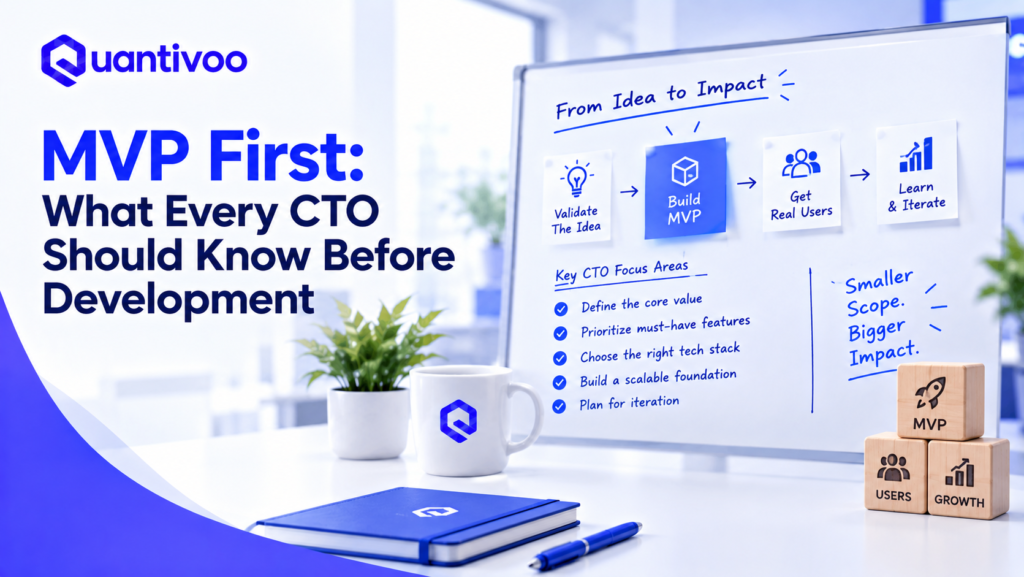
An MVP-first approach helps reduce that risk. Instead of developing a complete product immediately, the team identifies its most important assumptions, builds the smallest useful solution, and learns from real users before making larger investments.
Effective MVP development is not simply about delivering software faster or spending less. It is about aligning technical decisions with business priorities, validating demand, and creating a foundation for sustainable growth.
What Does an MVP-First Approach Actually Mean?
A Minimum Viable Product (MVP) is the simplest version of a product that delivers meaningful value to its intended users while generating enough evidence to test a specific business or product hypothesis.
An MVP-first approach places validation ahead of extensive implementation. The team defines what it needs to learn, identifies the essential functionality, and develops a product capable of producing useful feedback.
Understanding the difference between three common development stages helps clarify the objective.
| Product stage | Primary purpose | Typical output |
|---|---|---|
| Prototype | Explore an idea or demonstrate a concept | Wireframes, mockups, or clickable screens |
| MVP | Test assumptions with real users | A usable product with essential functionality |
| Mature product | Support broader needs and established requirements | Expanded features, integrations, and operational capabilities |
An MVP is not a collection of unfinished features or an excuse to ignore engineering quality. It should deliver its promised core value and meet appropriate security, reliability, and usability requirements.
The goal is to minimize unnecessary scope, not essential quality. A well-planned MVP makes learning possible without committing to every feature that a future product might need.
Why CTOs Should Validate Before Writing Code
Software teams frequently encounter uncertainty in five areas: customer demand, requirements, technical feasibility, delivery costs, and the relationship between engineering work and business objectives.
Validation helps address these uncertainties before they become expensive implementation decisions.
Uncertain customer demand. A product idea may sound compelling internally but fail to address a sufficiently important customer problem. Interviews and targeted experiments can reveal how users currently solve that problem and whether they want an alternative.
Unclear requirements. Customers may describe desired features without explaining the underlying problem. Product discovery helps distinguish essential capabilities from assumptions about what users need.
Unverified technical feasibility. A proposed integration, data-processing workflow, or performance requirement may introduce significant complexity. A focused technical spike can test the riskiest assumption before the team commits to a larger architecture.
Budget and timeline uncertainty. Early investigation exposes dependencies, operational requirements, and implementation risks that influence delivery estimates.
Overengineering and business misalignment. Teams can spend months building infrastructure for hypothetical traffic or implementing features that contribute little to the initial business objective. Validation helps engineering prioritize work according to evidence rather than speculation.
Useful pre-development techniques include:
- Customer interviews to investigate user problems and existing alternatives.
- Landing-page experiments to measure interest in a clearly described solution.
- Clickable prototypes to test workflows and usability.
- Technical spikes to investigate architectural or integration risks.
- Competitor research to understand market positioning and unmet needs.
However, evidence must be interpreted carefully. A sign-up or positive interview response indicates interest, not necessarily willingness to pay. Paid trials, repeated usage, retention, and purchasing behavior provide stronger evidence for different aspects of product viability.
How to Define the Right MVP Scope
MVP scope definition determines whether the first release generates meaningful learning or becomes a smaller version of an oversized product.
CTOs and product leaders can use this six-step framework.
- Identify the target user and problem. Specify who experiences the problem, when it occurs, and why existing solutions fall short.
- Define the core value proposition. Describe the main outcome the product should deliver, rather than listing its features.
- Document critical assumptions. Identify what must be true about customer demand, usability, technical feasibility, and commercial viability for the product to succeed.
- Prioritize features by value, risk, and learning potential. Give priority to capabilities required to deliver the core outcome or test an important assumption.
- Exclude nonessential functionality. Defer features that do not materially support the initial validation objective.
- Establish measurable success criteria. Decide what evidence would justify further investment before development begins.
Consider a scheduling platform. Its initial release might include account creation, availability management, and booking confirmation. Advanced analytics, complex automation, and extensive third-party integrations could wait until customer behavior demonstrates a need for them.
The smallest useful product is not necessarily the one with the fewest features. It is the simplest product that delivers its promised value and tests the assumptions that matter most.
Technical Decisions CTOs Must Make Before MVP Development
An MVP needs an appropriate technical foundation, but it rarely needs every architectural capability a mature enterprise platform might require.
Choose Technology Based on Requirements, Not Hype
Technology selection should reflect the team’s capabilities, delivery objectives, ecosystem maturity, maintainability requirements, integration needs, and expected workload.
A familiar, well-supported framework may be a better choice than a fashionable alternative that requires additional training or introduces unnecessary operational complexity.
CTOs should evaluate:
- Whether the team can develop and maintain the chosen stack.
- Availability of libraries, documentation, and community support.
- Compatibility with required APIs and existing systems.
- Deployment, hosting, and monitoring requirements.
- Likely performance, security, and data-management constraints.
The right technology stack is the one that satisfies current requirements while leaving reasonable options open for future change.
Build for Change Without Overengineering
Early architectural decisions influence how easily a product can evolve. Clear interfaces, modular components, separation of responsibilities, automated tests, and maintainable code help teams respond to new requirements without unnecessary rework.
For many early-stage products, a modular monolith is a sensible starting point. It keeps deployment and operations relatively straightforward while allowing the codebase to maintain clear internal boundaries.
Microservices may be justified when independent deployment, distinct scaling requirements, organizational boundaries, or other concrete constraints demand them. They also introduce distributed-system complexity, additional monitoring needs, and more operational overhead.
The distinction is between preparing for plausible change and implementing speculative infrastructure. Design for foreseeable requirements, but let evidence guide major architectural investments.
Address Security, Privacy, and Reliability Early
An MVP still needs appropriate safeguards. Depending on the product, these may include authentication, authorization, encryption, secure secrets management, input validation, backups, error handling, and monitoring.
CTOs should also identify applicable privacy laws, contractual obligations, and industry-specific compliance requirements before choosing how data will be collected, stored, and processed.
Security and compliance cannot always be postponed until a later release. A product handling sensitive information or operating in a regulated environment may require substantial foundational controls before real users can safely access it.
Plan for Integrations and Technical Constraints
Third-party dependencies can affect both cost and delivery. Investigate API limits, pricing, service availability, authentication requirements, data portability, and vendor lock-in before relying on an external service.
Identify difficult data migrations and integration dependencies early. If an important assumption remains uncertain, test it through a focused technical experiment rather than discovering the limitation after the main application has been built.
Budget, Timeline, and Team Planning for an MVP
MVP development cost depends on more than the number of screens or features. Technical complexity, integrations, team composition, security requirements, testing, infrastructure, and ongoing operations all influence the investment.
A realistic planning process should cover five areas:
- Budget: Estimate the essential development work, infrastructure, external services, and operational costs. State assumptions and identify major uncertainties.
- Team capabilities: Ensure the team has the product, engineering, design, testing, and operational expertise required for the chosen scope.
- Delivery milestones: Break work into demonstrable increments with decision checkpoints rather than relying on one distant launch date.
- Quality and operations: Account for testing, deployment, monitoring, backups, and maintenance.
- Contingency: Allow room for technical discoveries, requirement clarification, and feedback-driven adjustments.
Cost optimization should begin with reducing unnecessary scope and investigating high-risk assumptions early. Cutting essential testing, security, or maintainability work can create larger expenses after launch.
CTOs should also establish clear ownership of product decisions, technical trade-offs, and scope changes. Shared expectations help prevent the MVP from gradually expanding into a full-scale product before its central assumptions have been validated.
Common MVP Mistakes CTOs Should Avoid
Several recurring mistakes undermine the purpose of MVP development.
1. Building too many features. Excessive scope delays feedback and increases investment before demand is understood. Define the core user outcome and defer features that do not support it.
2. Confusing an MVP with a proof of concept. A proof of concept primarily investigates feasibility; an MVP must deliver enough value to test assumptions with users. Choose the deliverable according to the question being answered.
3. Choosing technology based on trends. A fashionable stack can introduce unfamiliar tools and unnecessary complexity. Evaluate options against requirements, team experience, and maintenance needs.
4. Ignoring security, testing, or maintainability. Shortcuts can expose users to risk and make subsequent changes expensive. Establish minimum quality standards before implementation.
5. Treating launch as the definition of success. Shipping confirms that software was delivered, not that the product solves a valuable problem. Agree on learning objectives and success metrics before release.
6. Collecting feedback without acting on it. Interviews and analytics have little value if they never influence priorities. Review findings regularly and document the decisions they inform.
7. Scaling infrastructure prematurely. Complex infrastructure consumes time and creates operational overhead without necessarily improving the user experience. Scale in response to observed workloads and credible requirements.
How to Measure MVP Success After Launch
MVP success metrics should reflect the hypothesis being tested and the product’s business model. There is no universal metric that proves every product is viable.
Relevant measures include:
- Activation rate: The proportion of new users who reach a meaningful first outcome.
- Task completion rate: How often users successfully complete the core workflow.
- Retention: Whether users return when they have a recurring need.
- Conversion rate: The proportion of users who take a desired next step.
- Time to complete a core task: Whether the product makes the intended activity sufficiently easy.
- Customer feedback: Qualitative evidence about usability, value, and unmet needs.
- Willingness to pay: Paid conversion, purchases, or other commercial signals where relevant.
- Cost to acquire and serve customers: Useful for evaluating commercial sustainability when enough data is available.
Downloads, page views, and sign-ups can help explain awareness or initial interest, but they do not independently demonstrate product-market fit.
CTOs should interpret quantitative data alongside customer interviews and observed behavior. A high sign-up rate paired with poor activation, for example, may indicate that the product’s promise attracts attention but its actual experience fails to deliver.
Use the findings to choose among four possible actions:
- Iterate when users experience friction that can be addressed.
- Expand scope when evidence supports additional capabilities.
- Change direction when the underlying problem remains valuable but the proposed solution is not working.
- Stop investing when critical assumptions repeatedly fail and there is insufficient justification for another experiment.
The objective is not to defend the original roadmap. It is to make better decisions as evidence improves.
A Practical Pre-Development MVP Checklist for CTOs
Before approving implementation, confirm that the team can answer the following questions.
- Is the target user and problem clearly defined?
- Is the core product hypothesis documented?
- Have the most important customer assumptions been investigated?
- Are MVP features prioritized against user value and learning objectives?
- Are success metrics and measurement methods agreed upon?
- Have major technical risks and dependencies been assessed?
- Are security, privacy, and relevant compliance requirements identified?
- Are budget, decision ownership, and delivery milestones established?
- Are testing, deployment, monitoring, and maintenance planned?
- Is there a defined process for gathering feedback and deciding what happens next?
If several answers remain unclear, further product discovery or technical investigation may be more valuable than immediately starting full-scale development.
Make the next move measurable
Have a digital challenge behind this question?
We can help connect the strategy, experience and execution so the work leads somewhere useful.
Discuss your project