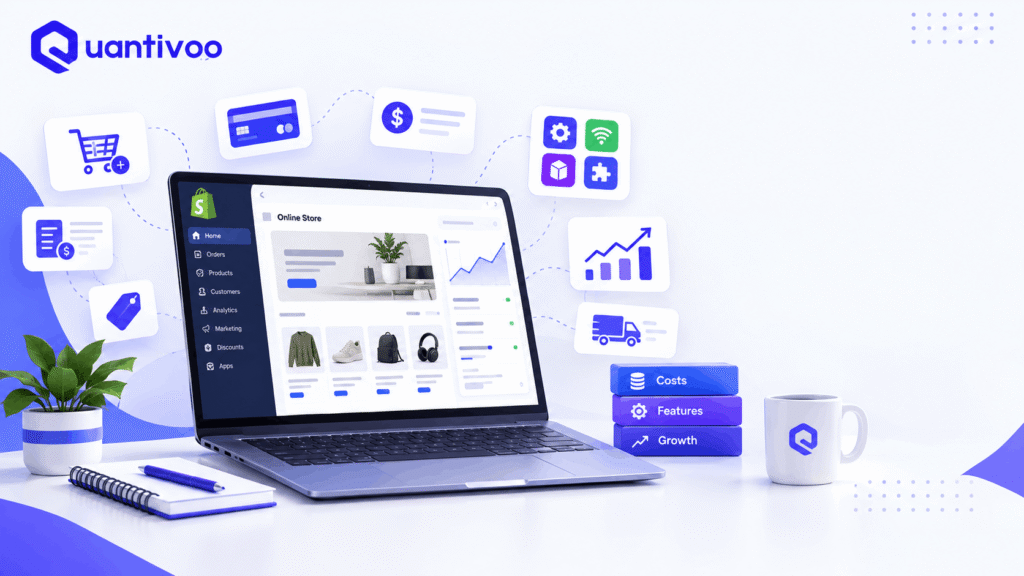
Is Shopify worth it? For many businesses, it can be—but the answer depends on what you are selling, how much technical control you need, what you can afford, and how much value you place on having a hosted e-commerce system rather than managing the technology yourself.
Shopify can give a business a storefront, product catalog, checkout, payment infrastructure, inventory tools, shipping features, analytics, marketing capabilities, and access to a large app ecosystem from one platform. That convenience has a price. Your real cost can be substantially higher than the monthly subscription once payment processing, apps, themes, domains, development, marketing, fulfillment, and other operating expenses are included.
The useful question, therefore, is not simply whether Shopify is “good.” It is whether the platform’s functionality, convenience, ecosystem, and scalability justify the total cost for your business.
This guide looks at Shopify pricing, additional expenses, advantages, disadvantages, SEO, dropshipping, small-business use cases, established businesses, alternatives such as WooCommerce and BigCommerce, and a practical framework for deciding whether Shopify makes financial and operational sense.
Is Shopify Worth It? Quick Answer
Shopify can be worth the cost if you need a hosted e-commerce platform that reduces technical administration while giving you room to manage products, payments, checkout, inventory, shipping, marketing, analytics, and multiple sales channels. It is particularly relevant to businesses that value convenience and want access to a large ecosystem of themes, apps, developers, and integrations.
It may be less suitable if you only need a basic website, have little reason to sell online, require unusually deep infrastructure control, or already have a platform that meets your requirements at a lower total cost.
The important distinction is between Shopify’s subscription price and the total cost of operating a Shopify store. The latter can include payment processing, apps, premium themes, domain registration, developers, marketing, shipping, fulfillment, and other business expenses.
What Is Shopify?
Shopify is a hosted commerce platform that lets businesses create and operate online stores without purchasing and maintaining their own web-server infrastructure.
Instead of installing e-commerce software on a server and managing updates, security, hosting, and much of the underlying infrastructure yourself, you subscribe to Shopify and operate the store through its administrative interface.
The platform combines several functions that would otherwise require multiple pieces of software:
- Online storefront
- Product and variant management
- Inventory management
- Shopping cart and checkout
- Payment processing integrations
- Order management
- Shipping configuration
- Marketing tools
- Analytics and reporting
- Customer accounts
- Themes and storefront customization
- Third-party applications
- Social and marketplace sales channels
- In-person selling through Shopify POS
- International commerce features
Shopify also provides built-in SEO controls. For example, Shopify automatically generates sitemap and robots.txt files, supports editable title tags, meta descriptions, URLs and image alt text, and provides SSL certificates for stores. These features make Shopify technically capable of supporting an SEO strategy, although they do not automatically produce search traffic.
That distinction matters.
A platform can provide technically sound SEO foundations while the store owner still needs to create useful product pages, build appropriate site architecture, earn relevant links and mentions, manage indexing, conduct keyword research, improve conversion rates, and create content that genuinely helps shoppers.
Google’s own e-commerce documentation emphasizes product information, site structure, structured data, Merchant Center data, and useful content rather than treating a particular e-commerce platform as a shortcut to rankings.
Shopify is also different from self-hosted e-commerce software.
With a self-hosted system, you generally have more direct control over hosting, server configuration, software versions, and infrastructure. You also inherit more responsibility for maintaining that environment.
With Shopify, you trade some infrastructure control for convenience.
That trade-off is central to the “Is Shopify worth it?” question.
If you are a business owner who would rather spend time improving products, acquiring customers, managing orders, and serving customers than maintaining servers, the hosted model can have considerable practical value.
If you have an in-house technical team and need deep infrastructure-level control, the same trade-off may look less attractive.
How Much Does Shopify Cost?
Shopify’s current US pricing page lists the main plans at $39/month for Basic when billed monthly, $105/month for Grow, and $399/month for Advanced. Shopify currently displays lower effective monthly prices of $29, $79, and $299 respectively when billed annually. Shopify Plus starts at $2,300/month under the current published pricing structure. Prices, payment rates, taxes, currencies, promotions, and availability can vary by location, so businesses should check the pricing applicable to their own market before purchasing.
| Shopify plan | Current US price, monthly billing | Current US effective monthly price when billed annually | General positioning |
|---|---|---|---|
| Basic | $39/month | $29/month | Solo/new businesses |
| Grow | $105/month | $79/month | Small teams/growing businesses |
| Advanced | $399/month | $299/month | Higher-volume/global operations |
| Plus | From $2,300/month | Contract-dependent | Complex/high-volume businesses |
Shopify also currently advertises a 3-day free trial followed by $1/month for three months on its US pricing page. Promotional offers can change, so treat those offers as temporary rather than as the normal cost of running a store.
But subscription cost is only one part of the calculation.
Shopify subscription cost
Your plan gives you access to the Shopify platform and the features associated with that tier.
The higher plans can make financial sense when additional capabilities or lower payment-processing rates matter enough to justify the higher subscription.
Shopify itself notes that higher-tier plans have lower credit-card rates and that, once sales volume is sufficiently high, the savings can potentially offset some of the additional subscription cost. The break-even point varies by location, payment setup, and sales volume.
Payment processing
Payment processing is another major cost.
If you use Shopify Payments where available, you pay the applicable card-processing rate. Rates vary by plan and market.
Shopify’s current US pricing page, for example, shows online standard card rates starting at 2.9% + $0.30 on Basic, 2.7% + $0.30 on Grow, and 2.5% + $0.30 on Advanced. These are not universal worldwide rates.
If you use a third-party payment provider instead, Shopify may also charge a third-party transaction fee. Shopify currently lists rates of 2% on Basic, 1% on Grow, and 0.6% on Advanced on its US pricing comparison. Again, the applicable rates depend on the store’s market and plan.
This is particularly important for businesses in countries where Shopify Payments is unavailable or where local payment gateways are commercially necessary.
Apps
Shopify’s app ecosystem is one of its strengths, but it can also become a significant expense.
A basic store might need very few paid applications. A more sophisticated operation could use separate tools for:
- Reviews
- Email marketing
- SMS
- Subscriptions
- Product bundles
- Advanced search
- Wholesale
- Customer loyalty
- Returns
- Accounting
- Shipping
- Product sourcing
- SEO
- Analytics
- Conversion optimization
A store that adds ten small subscriptions can easily create a much larger technology bill than the owner originally expected.
This is why “Shopify costs $39 a month” is an incomplete statement.
Themes
Shopify offers both free and paid themes. A free theme can be sufficient for a new business, particularly if the owner has a straightforward catalog and is willing to invest time in product photography, copywriting, navigation, and merchandising.
A premium theme can provide more design options and functionality, but it is not automatically necessary.
Shopify’s Theme Store includes free Shopify-developed themes as well as paid themes from third-party designers.
Domain
A custom domain is another normal business expense.
You can purchase a domain through Shopify or connect one purchased from another registrar. If you already own a domain elsewhere, you do not have to transfer it to Shopify; you can connect it while continuing to manage its renewal and DNS settings through the third-party provider.
Developers and agencies
You may never need a developer.
However, custom integrations, advanced theme work, migrations, custom apps, unusual checkout requirements, ERP connections, or complex B2B functionality can create development costs.
These expenses are not uniquely a Shopify problem. They are part of operating almost any serious e-commerce system.
Marketing
Shopify does not include customers.
You may need to budget for:
- Search engine optimization
- Paid search
- Social advertising
- Influencer marketing
- Content creation
- Photography
- Email marketing
- Affiliate programs
- Marketplace fees
- Creative production
This is one of the easiest costs for a new store owner to underestimate.
A practical small-store example
Imagine a hypothetical small brand using the annual-billing equivalent of Shopify Basic.
The store might have:
- Shopify subscription: about $29/month
- Domain: perhaps a typical annual domain renewal
- Apps: $40/month
- Email/SMS tools: $30/month
- Paid theme: amortized over its useful life
- Payment processing: variable based on sales
- Advertising: $500/month
- Shipping and fulfillment: variable
- Product costs: variable
The platform subscription is therefore only one line in the operating budget.
If the store generates $5,000 in monthly sales, payment processing alone can represent a meaningful amount. If the store generates $50,000, the payment economics become much more significant—and the question of whether a higher Shopify plan makes sense becomes more relevant.
The lesson is simple: calculate total cost of ownership, not just the advertised subscription.
Shopify’s Main Advantages
Easy Store Setup
Shopify is designed to reduce the technical work involved in launching an online store.
You do not need to arrange separate web hosting before creating the basic storefront. You can choose a theme, add products, configure payments, set shipping rules, connect a domain, and start working toward launch from the same administrative environment.
That does not mean creating a successful store is easy.
Adding 20 products is easy compared with building a profitable merchandising strategy for those 20 products.
The platform simplifies technology. It does not simplify product-market fit, customer acquisition, fulfillment, pricing, or customer service.
Hosted Infrastructure
The hosted model is one of Shopify’s strongest practical arguments.
Shopify includes web hosting, SSL/TLS, and the underlying commerce infrastructure with its plans. You do not need to maintain a WordPress server, configure PHP versions, patch a database, or manage a separate hosting account simply to keep the store operational.
That can be valuable for a small business without a dedicated technical team.
It also changes the nature of technical risk. You still need to worry about theme quality, apps, integrations, tracking, page performance, and configuration, but you have less responsibility for the underlying server environment.
Professional Checkout
Checkout is one of the most commercially important parts of an online store.
A beautiful homepage cannot compensate for a confusing checkout process.
Shopify provides a standardized checkout ecosystem with payment methods and features that can be extended depending on the plan, market, and payment setup.
The practical benefit is not that Shopify magically converts visitors. It is that you begin with established commerce infrastructure rather than designing a payment flow from scratch.
App Ecosystem
The Shopify App Store allows merchants to add functionality without building every feature themselves.
That can dramatically shorten development time.
For example, a business might add a subscription system in an afternoon rather than commissioning a custom subscription engine.
The trade-off is dependency.
Every app introduces another vendor, another update cycle, another potential compatibility issue, and often another recurring bill.
A useful rule is:
Install an app because it solves a measured business problem—not because the App Store contains it.
If an app improves conversion, reduces support workload, automates a manual process, or unlocks required functionality, its cost may be justified.
If it adds a decorative feature nobody uses, it is probably technology overhead.
Themes and Customization
Shopify’s theme ecosystem allows a store owner to start from an established design rather than commissioning an entire storefront.
Free themes can be enough for many stores. Paid themes and custom development provide additional flexibility.
The platform is therefore capable of supporting anything from a simple product catalog to a highly branded retail experience.
However, “customizable” does not mean infinitely customizable.
Shopify operates within its own architecture. Deeply unusual business rules may require workarounds, apps, custom development, or a different commerce architecture.
Scalability
Shopify can serve businesses at very different stages.
A new entrepreneur may start on Basic. A growing company may move to Grow or Advanced. Larger businesses can evaluate Shopify Plus.
The important point is that scalability is not simply a question of traffic.
A store can have modest traffic but complicated operations.
For example, a growing brand might need:
- Multiple inventory locations
- More staff access
- Advanced reporting
- International storefronts
- Custom integrations
- B2B catalogs
- More sophisticated fulfillment
- Higher API capacity
Shopify’s higher plans and broader ecosystem can address many of these requirements.
That does not mean every large company should use Shopify. Complex businesses should compare the platform against their architecture, integration, compliance, data, B2B, and operational requirements.
Omnichannel and Sales Channels
Shopify supports more than the store at example.com.
Depending on eligibility and configuration, merchants can connect sales channels such as social platforms, marketplaces, Google, Shop, and in-person retail.
The value is operational: products and orders can be managed from a central commerce environment rather than maintained separately across every channel.
That becomes more useful as a business adds sales channels.
Ecosystem and Support
A platform’s ecosystem has economic value.
Shopify has documentation, developers, agencies, app developers, theme developers, educational resources, and a large merchant community.
If you eventually need a developer, analytics specialist, SEO consultant, migration expert, or custom integration, there is a substantial ecosystem of people familiar with the platform.
That availability can reduce the risk of being dependent on one individual developer.
Shopify’s Disadvantages
Monthly Subscription Costs
A recurring subscription is not necessarily bad.
It becomes a problem when the store’s economics cannot support it.
A business making its first few sales needs to think differently from a business processing tens of thousands of dollars in orders every month.
The right question is not “Can I afford $39?”
It is “Does the platform create enough operational or commercial value to justify the full technology bill?”
Additional App Costs
Apps are perhaps the most common source of Shopify cost creep.
A store can start with a simple subscription and gradually acquire:
- $10 review app
- $20 upsell app
- $30 subscription app
- $25 SEO app
- $40 analytics tool
- $50 loyalty platform
None looks enormous individually.
Together, they can become a meaningful monthly expense.
Before installing an app, determine whether Shopify already provides the functionality, whether the feature actually affects revenue or efficiency, and whether the app’s cost scales with orders, revenue, contacts, or usage.
Transaction and Payment Fees
Payment costs deserve careful attention.
Shopify Payments can simplify the payment setup where available. Businesses using external payment providers may face additional Shopify transaction fees depending on their plan and market.
That makes payment-provider availability an important part of the platform decision.
A store owner should check:
- Whether Shopify Payments is available in their country.
- Which local payment methods customers expect.
- The card-processing rate.
- Any additional Shopify transaction fee.
- Currency-conversion costs.
- Cross-border payment considerations.
- Payout timing and operational requirements.
Do not assume that payment economics in the United States apply to another country.
Customization Limitations
Shopify is flexible, but it has boundaries.
Some businesses want highly specialized product configurators, unusual pricing engines, complicated account structures, custom checkout behavior, or deep control over infrastructure.
Those requirements can be addressed through APIs, apps, custom development, or Shopify’s higher-tier offerings in some cases.
But “possible” and “simple” are different things.
If a store’s competitive advantage depends on functionality that requires extensive workarounds, the platform should be evaluated very carefully.
Dependence on Third-Party Apps
Apps create another form of technical debt.
If an app becomes critical to your checkout, subscriptions, reviews, customer data, or fulfillment workflow, you become partially dependent on the company that maintains it.
Before adopting a critical app, consider:
- How long the vendor has operated
- Support quality
- Export capabilities
- Pricing structure
- Data ownership
- Compatibility with your theme
- Compatibility with other apps
- What happens if the app shuts down
- Whether the functionality can be replaced
The more apps a store accumulates, the more important this becomes.
Migration Considerations
You can move away from Shopify, but migration is not frictionless.
Products, customers, orders, URLs, content, images, redirects, analytics, payment systems, subscriptions, apps, and integrations all need consideration.
SEO makes migration particularly sensitive.
Changing URL structures can create broken links, lost rankings, indexing problems, or confusing signals if redirects and internal links are not handled correctly.
For an established store, platform migration should therefore be treated as a project—not as a weekend settings change.
Learning Curve
Shopify is beginner-friendly compared with many technically demanding e-commerce systems.
Running a good business is not.
A store owner still needs to understand:
- Product selection
- Pricing
- Gross margins
- Merchandising
- Product photography
- SEO
- Conversion optimization
- Customer acquisition
- Analytics
- Inventory
- Returns
- Fulfillment
- Customer service
Shopify can remove some technical barriers. It cannot replace business judgment.
Is Shopify Worth It for Beginners?
For a beginner who genuinely needs an online store, Shopify can make sense because it reduces the amount of infrastructure that has to be assembled before selling.
A first-time entrepreneur can focus on product pages, branding, pricing, fulfillment, and marketing rather than learning server administration.
That is a meaningful benefit.
But beginners should avoid a common mistake: spending heavily on the store before validating the business.
A new entrepreneur does not necessarily need:
- A $400 theme
- Fifteen paid apps
- A custom-coded homepage
- Multiple automation tools
- Advanced analytics software
A simple store with good product photography, clear descriptions, trustworthy policies, straightforward navigation, and reliable fulfillment can be more useful than an expensive store full of features.
Shopify is worth considering for a beginner when the business genuinely intends to sell products online and the recurring technology expense fits the startup budget.
It may be less appropriate if the person is only testing an idea and could validate demand through a marketplace, social selling, a landing page, or another lower-cost approach first.
The platform should follow the business model—not the other way around.
Is Shopify Worth It for Small Businesses?
Shopify can be a practical fit for small retailers, independent brands, solo entrepreneurs, and local businesses expanding into e-commerce.
The strongest case is usually operational.
Suppose a small retailer already sells products in a physical shop and wants an online channel.
The store now needs:
- Product listings
- Inventory tracking
- Online payments
- Order management
- Shipping rules
- Customer notifications
- Promotions
- Analytics
Shopify can bring many of those functions together.
The business still needs to calculate whether the convenience justifies the cost.
Imagine a hypothetical store generating $8,000 per month in online revenue with healthy gross margins. A few hundred dollars of monthly technology and marketing expenses may be relatively manageable if the platform saves significant staff time and supports sales.
Now imagine a business generating only $300 per month and selling products with very low margins.
The same technology bill could be difficult to justify.
Revenue alone is not the deciding factor. Margin, operational complexity, expected growth, and alternatives matter too.
Is Shopify Worth It for Dropshipping?
Shopify is commonly used for dropshipping because it provides the storefront, checkout, product catalog, order management, and an ecosystem of supplier and fulfillment integrations.
A typical workflow might look like:
- Choose a product category.
- Create a Shopify store.
- Connect a supplier or dropshipping application.
- Import or create product listings.
- Configure pricing and shipping.
- Connect payment processing.
- Market the products.
- Forward or automate orders to the supplier.
- Handle customer communication and returns.
The technology can be relatively straightforward.
The economics are not.
Dropshipping businesses can face:
- Thin margins
- Supplier quality problems
- Shipping delays
- Product inconsistencies
- Refunds
- Chargebacks
- Advertising costs
- Intense competition
- Customer-service workloads
- Inventory availability problems
If a supplier takes three weeks to deliver a product, the customer generally does not care that a Shopify app caused the order to be routed correctly. They blame the store.
That makes supplier selection, delivery expectations, product quality, support, and returns just as important as the website.
Shopify is a commerce platform, not a profitability engine.
It can provide the technology needed to operate a dropshipping business, but it cannot make an uncompetitive product profitable.
Is Shopify Worth It for Established Businesses?
An established business has a different calculation.
It may already have sales, customers, staff, inventory systems, accounting software, warehouses, CRM systems, ERP software, marketplaces, and physical stores.
For that business, the question is often not “Can Shopify build a website?”
It is:
Can Shopify simplify or improve the overall commerce operation without creating unacceptable migration or integration costs?
Potential benefits include:
- Centralized product management
- Multiple sales channels
- Inventory management
- Analytics
- Shipping workflows
- Staff permissions
- Integrations
- International selling
- B2B commerce capabilities
- Developer ecosystem
- Custom applications
- Automation
The migration cost must also be considered.
An established business may have thousands of URLs, years of organic search visibility, complex customer data, subscriptions, integrations, custom applications, and historical order information.
Moving platforms without a migration plan can create unnecessary technical and commercial risk.
For a large company, Shopify Plus may be relevant because it adds enterprise-oriented capabilities such as customizable checkout, higher API limits, B2B functionality, expansion stores, and other advanced features. But those requirements should be assessed against the company’s architecture rather than assumed to justify a migration.
Shopify vs Other E-Commerce Platforms
There is no universal winner among e-commerce platforms.
The appropriate choice depends on how much control, convenience, built-in functionality, hosting responsibility, customization, and technical expertise the business requires.
| Platform | May suit | Main consideration |
|---|---|---|
| Shopify | Businesses wanting hosted e-commerce and a broad ecosystem | Recurring platform, payment, and app costs |
| WooCommerce | WordPress users wanting substantial control and flexibility | Hosting, maintenance, security, and extensions become the merchant’s responsibility |
| BigCommerce | Businesses evaluating hosted commerce with a broad built-in feature set | Pricing and plan mechanics should be assessed against sales volume and payment setup |
| Wix | Smaller businesses wanting website building and commerce in one system | More advanced commerce requirements may need careful evaluation |
| Squarespace | Businesses prioritizing design, content, and relatively straightforward commerce | Requirements for more complex commerce operations should be checked |
| Adobe Commerce | Larger or technically sophisticated businesses with complex commerce requirements | Greater implementation and technical-resource requirements |
Shopify vs WooCommerce
WooCommerce is free, open-source e-commerce software for WordPress. That does not mean a WooCommerce store is free to operate.
You still need hosting, a domain, payment processing, extensions, security, maintenance, backups, and potentially development.
WooCommerce can be attractive when control and WordPress integration are priorities.
Shopify can be attractive when reducing infrastructure management is more important.
The cost comparison should therefore be:
Shopify subscription + apps + development
versus
WooCommerce hosting + extensions + maintenance + development.
Comparing only the core software price gives a misleading picture.
Shopify vs BigCommerce
BigCommerce is another hosted e-commerce platform. Its current pricing structure includes Core, Growth, Scale, and Performance plans, with pricing and plan thresholds tied partly to sales volume.
One practical difference is how the two companies structure payment-provider economics and plan upgrades.
BigCommerce’s current pricing documentation, for example, describes GMV thresholds and additional fees for certain open payment providers.
A business comparing the two should model its own payment provider, sales volume, required features, and projected growth rather than relying on a generic “Shopify vs BigCommerce” ranking.
Shopify vs Wix
Wix can be appealing to businesses that think of themselves primarily as websites with commerce capabilities.
Shopify is more explicitly commerce-centered.
If the business is primarily content, services, branding, and a small product catalog, Wix can deserve consideration.
If the core operation is product sales, inventory, fulfillment, merchandising, and multiple sales channels, a dedicated commerce platform may be a more natural starting point.
Shopify vs Squarespace
Squarespace can be particularly appealing when visual presentation and content are central to the website.
A small brand selling a limited range of products may find that approach sufficient.
As commerce operations become more complicated, the evaluation should shift toward inventory, integrations, fulfillment, payment methods, reporting, staff workflows, and scalability.
Shopify vs Adobe Commerce
Adobe Commerce is aimed at much more complex commerce environments.
It can make sense where businesses need extensive customization, sophisticated catalogs, B2B requirements, complex pricing, multiple brands or markets, and substantial technical resources.
That flexibility comes with greater implementation complexity.
A small business usually should not select enterprise software simply because it offers more theoretical control.
Shopify Costs vs. Potential Business Value
The simplest way to evaluate Shopify is to compare total cost with business value.
Think of the equation this way:
Potential value = functionality + time saved + operational efficiency + reliability + scalability
versus
Total cost = subscription + payment fees + apps + themes + development + marketing + other operating expenses
The “time saved” component is easy to overlook.
Suppose a business owner could spend six hours each week dealing with hosting, updates, server configuration, backups, and technical troubleshooting on a self-hosted platform.
If Shopify removes most of that work, the subscription has economic value beyond the visible features.
But the opposite can also be true.
If a business has an experienced technical team and already operates reliable infrastructure, paying for a hosted platform may provide less incremental value.
Scenario 1: First-Time Entrepreneur
This hypothetical entrepreneur has 15 products, limited technical knowledge, and a modest startup budget.
Shopify may be worth considering because the entrepreneur can launch without building a hosting stack.
The priority should be keeping the technology simple.
Start with a basic plan, free theme, essential payment setup, minimal apps, and a custom domain.
Spend more attention on product-market fit and customer acquisition than on decorative store features.
Scenario 2: Small Established Brand
This hypothetical brand already has repeat customers and consistent online orders.
Its calculation is different.
The business may value Shopify’s inventory, order, shipping, analytics, marketing, and sales-channel capabilities enough to justify recurring costs.
It should compare the full Shopify bill with the cost of maintaining its existing platform, including staff time and technical support.
Scenario 3: Dropshipping Store
This hypothetical store is testing several products and expects to acquire customers through paid advertising.
The biggest risk is not whether Shopify can process the orders.
It is whether the product economics work after advertising, payment fees, refunds, shipping, supplier costs, and customer service.
Shopify can facilitate the operation but cannot solve poor margins.
Scenario 4: Growing E-Commerce Business
This hypothetical business is expanding internationally and has a larger team.
It now cares about:
- Staff access
- Inventory locations
- International selling
- Reporting
- API limits
- Integrations
- B2B
- Fulfillment
- Automation
At this stage, the business should evaluate the platform as infrastructure rather than merely as a website builder.
Higher Shopify plans may become relevant, but the decision should be based on measurable requirements and total cost.
Scenario 5: Highly Customized Commerce Operation
Consider a hypothetical business with unusual pricing logic, a complex product configurator, proprietary infrastructure, and extensive internal development resources.
Shopify may still be possible, but the cost of adapting the business to the platform could outweigh the convenience of its hosted architecture.
This is precisely the kind of case where a platform comparison should happen before implementation.
When Shopify May Not Be Worth It
Shopify may be unnecessary when:
- You only need an informational website.
- You do not actually plan to sell products online.
- Your online sales volume is too low to justify the recurring technology cost.
- A platform you already own handles your requirements adequately.
- You require infrastructure-level control.
- Your business depends on highly specialized functionality that is awkward to implement in Shopify.
- Your preferred payment methods or local commerce requirements are poorly supported.
- You have a technically capable team that would gain little from a hosted platform.
- You are validating an idea and can test demand through a cheaper channel first.
None of these means Shopify is a poor platform.
It means platform value is contextual.
Paying for sophisticated commerce infrastructure before you have a business that needs it can be as inefficient as trying to run a large e-commerce company on a tool that has become too restrictive.
How to Decide If Shopify Is Worth It for You
Before signing up, answer these questions.
1. What are you selling?
Physical products, digital products, subscriptions, services, wholesale goods, and complex configurable products can have very different requirements.
2. How many products will you have?
Ten products and 100,000 SKUs create very different inventory, navigation, filtering, and operational challenges.
3. What is your expected monthly revenue?
Do not use revenue alone. Estimate gross margin and contribution margin as well.
A $10,000/month store with healthy margins is economically different from a $10,000/month store with very low margins.
4. What is your technical skill level?
If you do not want to manage hosting and infrastructure, Shopify’s hosted model may have more value.
5. How much customization do you need?
Write down your non-negotiable requirements before choosing the platform.
6. Which payment methods do your customers use?
This is especially important internationally.
Check whether the required payment provider is available and what fees apply.
7. How many third-party apps will you need?
Build an estimated app budget before launching.
8. Do you need integrations?
Check compatibility with accounting, ERP, CRM, fulfillment, email, marketplaces, shipping providers, and other critical systems.
9. How important is scalability?
If you expect rapid growth, evaluate what happens at your projected next stage—not just what works today.
10. What is your total technology budget?
Include the subscription, apps, domain, development, marketing software, payment costs, and other technology expenses.
11. Do you need SEO?
Shopify has built-in SEO capabilities, but your organic performance will depend on much more than the platform.
Evaluate:
- URL structure
- Product architecture
- Internal linking
- Product content
- Structured data
- Page experience
- Indexability
- Content strategy
- Digital authority
Google recommends making product information understandable through structured data and Merchant Center feeds where appropriate, while also emphasizing useful e-commerce content and crawlable site architecture.
12. Do you need multiple sales channels?
If you plan to sell through your website, marketplaces, social channels, or physical retail, centralized management may become more valuable.
13. What are your shipping requirements?
Map your locations, shipping zones, rates, carriers, fulfillment centers, returns, and international requirements.
Shopify provides shipping profiles, rates, locations, order routing, fulfillment workflows, and integrations, but actual shipping costs remain a business expense.
14. How important is support?
A business owner who wants a large ecosystem of documentation, apps, developers, agencies, and support resources may place significant value on Shopify’s ecosystem.
15. How difficult would migration be later?
If your store may become large, choose its URL architecture, product structure, integrations, and data strategy carefully from the beginning.
Shopify Pros and Cons at a Glance
| Pros | Cons |
|---|---|
| Hosted infrastructure | Recurring subscription |
| Relatively accessible setup | Apps can increase costs |
| Integrated commerce administration | Payment fees vary by plan and market |
| Large app ecosystem | App dependency can create complexity |
| Free and paid themes | Customization has architectural limits |
| Built-in SEO controls | SEO still requires substantial work |
| Inventory and order management | Some advanced functionality costs more |
| Multiple sales channels | Some payment providers may add extra fees |
| Scalable plan structure | Migration can be complex for established stores |
| Large developer/partner ecosystem | Not ideal for every highly specialized architecture |
Frequently Asked Questions
Is Shopify worth it for a small business?
Shopify can be worth it for a small business that genuinely needs a dedicated online store and values hosted infrastructure, payment and checkout functionality, inventory tools, and an established commerce ecosystem. The key is whether the total monthly cost fits the business’s margins and sales volume. A very small business with minimal online sales may find a simpler platform more economical.
Is Shopify worth it for beginners?
Shopify can be beginner-friendly because it removes much of the server and hosting administration involved in running an online store. However, beginners still need to learn product merchandising, pricing, marketing, SEO, fulfillment, analytics, and customer service. Shopify can simplify the technology without making the underlying business easy.
Is Shopify worth the monthly fee?
That depends on what the monthly fee replaces or enables. If Shopify eliminates substantial hosting and maintenance work and provides commerce capabilities you would otherwise need to assemble separately, its subscription may be justified. If you barely use its e-commerce features, the recurring fee may be harder to justify.
Can you make money with Shopify?
Yes, businesses can make money selling through Shopify, but Shopify itself does not create demand or guarantee profitability. Your result depends on factors such as product economics, pricing, margins, customer acquisition, conversion rate, fulfillment, competition, retention, and customer service. Platform selection is only one part of the business model.
Is Shopify good for dropshipping?
Shopify can provide the technical infrastructure needed for dropshipping, including storefront, checkout, product management, order processing, and integrations. The bigger issue is business economics. Supplier reliability, shipping times, advertising costs, refunds, product quality, margins, and customer support can determine whether a dropshipping operation works.
Is Shopify better than WooCommerce?
Neither is universally better. Shopify generally puts more responsibility for infrastructure management on the platform, while WooCommerce gives WordPress users substantial control over hosting and extensions. WooCommerce is free open-source software, but hosting, maintenance, security, extensions, and development still cost money. The better fit depends on technical expertise, desired control, budget, and business requirements.
What are the hidden costs of Shopify?
The costs most often overlooked are not necessarily hidden; they are simply outside the headline subscription. They can include payment processing, third-party transaction fees, paid apps, premium themes, domains, developer work, marketing software, shipping, fulfillment, and advertising. Before subscribing, build a total monthly operating-cost estimate rather than budgeting only for the Shopify plan.
Can you use Shopify without technical knowledge?
Yes. Shopify is designed to allow people without programming experience to build and operate stores. However, technical knowledge becomes useful as requirements become more complex. Custom integrations, theme modifications, advanced analytics, APIs, migrations, performance issues, and unusual business logic may require a developer.
Is Shopify good for SEO?
Shopify provides many technical SEO foundations, including editable metadata, canonical tags, automatically generated sitemap and robots.txt files, SSL, and other storefront controls. But no e-commerce platform guarantees organic rankings. Product quality, search intent, site architecture, content, internal linking, structured data, authority, technical performance, and customer usefulness still matter.
Can I start Shopify with no money?
You should not plan on running a real commercial store indefinitely with no budget. Shopify may offer a trial or promotional introductory pricing, but a functioning business normally needs a domain, payment processing, products or inventory, packaging or fulfillment, marketing, and other operating expenses. You can minimize initial technology costs, but e-commerce itself is not cost-free.
What are the disadvantages of Shopify?
The main considerations are recurring subscription costs, payment-related fees, app expenses, dependence on third-party applications, limits on certain kinds of customization, and the effort involved in migrating away later. Shopify is also unnecessary for businesses that do not need sophisticated e-commerce functionality.
Can I cancel Shopify anytime?
Shopify allows eligible store owners to cancel and deactivate their stores through the Shopify admin, generally at the end of the current billing cycle. Shopify also provides a pause option for eligible stores. Subscription terms and Plus commitments can differ, so check your specific plan before cancellation.
Shopify Worth-It Checklist
Use this checklist before committing:
- I need a dedicated online store.
- I want a hosted platform.
- I am comfortable with recurring software costs.
- I need payment and checkout functionality.
- I have checked payment-provider availability in my market.
- I have estimated payment-processing costs.
- I may need third-party integrations.
- I have estimated my likely app costs.
- I want room to scale.
- I don’t want to manage server infrastructure.
- Shopify’s features match my business requirements.
- I have considered SEO and content requirements.
- I have considered shipping and fulfillment.
- I have compared at least one alternative.
- I understand my total technology budget, not just the subscription price.
So, Is Shopify Worth It?
Shopify may be worth it when the business needs a hosted e-commerce platform and the convenience, functionality, ecosystem, and scalability justify the recurring cost.
It is particularly worth evaluating when:
- The business needs a dedicated online store.
- Hosted infrastructure is preferable to server management.
- The business needs integrated checkout and payment functionality.
- Product, order, inventory, and shipping management matter.
- Third-party integrations are important.
- The business expects to sell online consistently.
- The owner values access to a large ecosystem of apps, developers, themes, and agencies.
- The total technology budget can comfortably support the platform.
Shopify may be less suitable when:
- The business needs only a basic informational website.
- Recurring platform costs are difficult to justify.
- Another platform already meets the requirements.
- Maximum infrastructure control is a priority.
- Highly specialized functionality is central to the business.
- Local payment or commerce requirements make another platform more practical.
The most useful way to think about Shopify is not as a cheap or expensive website builder. It is a commerce operating platform.
Its value comes from the amount of technology and operational infrastructure you can avoid assembling yourself.
For one business, that convenience may be worth considerably more than the subscription. For another, it may be unnecessary overhead.
Before signing up, calculate the total cost of ownership, identify the capabilities you actually need, check payment availability in your market, estimate app and development expenses, and compare at least one alternative.
If those numbers and requirements line up, Shopify can be a rational platform investment. If they do not, there is no reason to choose it simply because it is popular.
The right e-commerce platform is the one whose total cost, capabilities, technical model, and operational trade-offs fit the business you are actually building.
Make the next move measurable
Have a digital challenge behind this question?
We can help connect the strategy, experience and execution so the work leads somewhere useful.
Discuss your project