


Step 01
Conversion Baseline
Review analytics, forms, funnels, page behavior and business goals before deciding what to test or fix.
01 / 06
Conversion Rate Optimization
Quantivoo helps teams that want more action from the traffic they already have plan and improve Website Conversion Audit. The work focuses on friction points, messaging, forms, tests and evidence, so visitors, buyers or users get clearer reasons to trust the next step and your team can measure what changed.







Proof-led
Project delivery
7
Markets served
10
Service disciplines
Measured
Against agreed outcomes
Website Conversion Audit work best when changes are based on evidence, not opinions. The biggest leaks usually sit in unclear offers, friction, weak proof, form anxiety or mismatched traffic intent. Quantivoo connects Website Conversion Audit to analytics, buyer objections and practical experiments so improvements have a reason behind them.
For Website Conversion Audit, Quantivoo starts with buyer objections, then connects the work to conversion rate, revenue per visitor, lead quality, checkout progress and experiment learnings. That keeps the strategy relevant to teams needing evidence before redesign instead of feeling like a generic agency checklist.
Strategy lens
We turn demand into a clear scope, then measure the path from attention to a qualified inquiry.
01
Intent map
02
Clean scope
03
Measured next step
What's included
conversion audit
We define what the buyer, user or shopper must understand before they can trust the next step.
hypothesis backlog
We turn the strategy into practical prioritized CRO audit requirements, not abstract recommendations.
page or funnel recommendations
We check the operational details that affect quality: tools, data, platform limits, tracking and handoff.
testing and iteration plan
We finish with measurement notes so your team can review performance and improve with evidence.
This Website Conversion Audit process is shaped around the real decisions, assets and checks the service needs, so the work feels specific instead of copied from another page.
Step 01
Review analytics, forms, funnels, page behavior and business goals before deciding what to test or fix.
01
We organize website conversion audit around where visitors hesitate, what they need clarified and what action should become easier.
02
The page connects analytics, behavior signals, messaging, proof and experiment priorities.
03
Scope, FAQs, outcomes and next steps help buyers understand what will be reviewed, changed and measured.
04
Every section points toward a useful improvement path instead of vague promises about more conversions.
From the first search-led recommendation to the final implementation, our website conversion audit services are structured to remove friction, clarify the offer and create a stronger path to action.
Scoped around the search intent, commercial goal and buying questions behind conversion audit.
Presented clearly so users understand what hypothesis backlog includes and why it matters before they enquire.
Connected to the wider website conversion audit system instead of being delivered as an isolated task.
Checked for usability, performance and the small points of friction that can quietly reduce conversion rate.
You get a focused team that combines strategic thinking, careful execution and practical support around one clear website conversion audit outcome.
We start website conversion audit by identifying where users hesitate, abandon or misunderstand the next step.
Analytics, page behavior, message clarity and user intent shape what should be tested or improved.
Headlines, proof, forms, CTAs and page hierarchy are tuned to make the offer easier to evaluate.
Events, goals and lead quality signals are checked so improvements can be judged by more than opinion.
Recommendations are organized by likely impact, effort and confidence so the team knows what to do first.
We keep improving website conversion audit as traffic sources, offers, user behavior and sales feedback change.
Clearer relevance for people searching for Website Conversion Audit.
Stronger trust through specific website conversion audit scope, process and proof.
Better decision paths measured through conversion rate, revenue per visitor, lead quality, checkout progress and experiment learnings.
Editable page content that stays in the service source file for future manual updates.
Structural previews, not a client case study — full project galleries publish once real screens are approved.
Website Conversion Audit
conversion audit
hypothesis backlog
page or funnel recommendations
Website Conversion Audit rarely stands alone — here's what usually pairs with it.
Good website conversion audit work should make the next business decision easier. Here is how clients describe the clarity, care and momentum they experienced working with Quantivoo.
If you are comparing options, these related pages give you a clearer view of the wider service, available markets and the next practical step.
Related service
See the wider conversion rate optimization offer and how this service fits into the broader growth plan.
Back to Conversion Rate OptimizationAvailable markets
Explore how the same service is positioned for different markets and business contexts.
Find it locally
See the service through the priorities, market language and opportunities of each city.
The practical details buyers usually want to understand before committing to website conversion audit work.
It depends on the goal, but the scope usually covers friction points, messaging, forms, tests and evidence. Quantivoo defines the priority work before production starts, so the engagement stays clear instead of becoming a long checklist.
It is a strong fit if you already know something needs to improve but need clearer priorities, better execution or stronger measurement. We first review your current situation, audience and business goal before recommending a scope.
We begin with the context: your offer, audience, current assets, performance data where available and the action you want people to take. That gives the project a practical direction before design, content or technical work begins.
Success is measured against useful business signals, not activity alone. Depending on the service, that can include qualified enquiries, conversion quality, search visibility, engagement, revenue signals, user behaviour and completed improvements.
Yes. Quantivoo can review the existing setup, keep what is working and improve the parts that create friction, weak trust, unclear messaging or poor measurement.
Some improvements can be visible quickly, such as clearer messaging, better page structure or cleaner tracking. Larger performance gains depend on the starting point, competition, approvals and how quickly changes can be launched.
Useful starting points include your goals, current website or channel links, target audience, main offer, analytics access where relevant, brand assets and examples of competitors or references you want us to understand.
Quantivoo shapes the work around the decision your customer needs to make. The aim is clearer evidence about what stops visitors from converting, with a scope your team can understand, review and improve after launch.
Tell us what you want to improve. We will map the right strategy, website, marketing or automation path.
The newest strategy, design, technology and growth articles, updated automatically whenever a new post is published.

A startup idea can sound convincing in your head. You may have identified a problem, imagined an elegant solution, and pictured customers lining up to buy it. But assumptions about customer demand, competition, pricing, and profitability can be wrong—even when the idea initially seems promising. The challenge is not simply coming up with a good
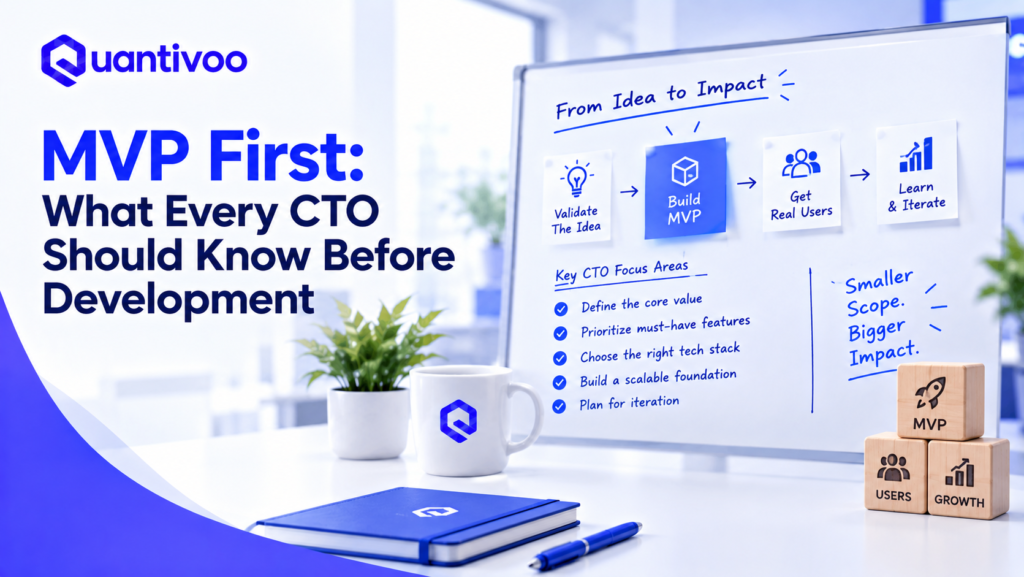
A product launch is approaching. The business team wants a feature-rich platform, investors expect visible progress, and engineering has a limited budget and an ambitious deadline. Yet one critical question remains unanswered: are the proposed features solving a problem customers are willing to pay to solve? For a CTO, this uncertainty can make software development

SaaS Idea can still fail if it solves a weak problem, targets the wrong customer, takes too long to reach the market, or makes the product difficult to adopt. Conversely, a relatively simple product can become a strong SaaS business when it solves an expensive, recurring problem for a clearly defined group of customers. That